

from design to uptake
Societal impact in EU-funded research
Four competences, one category of impact
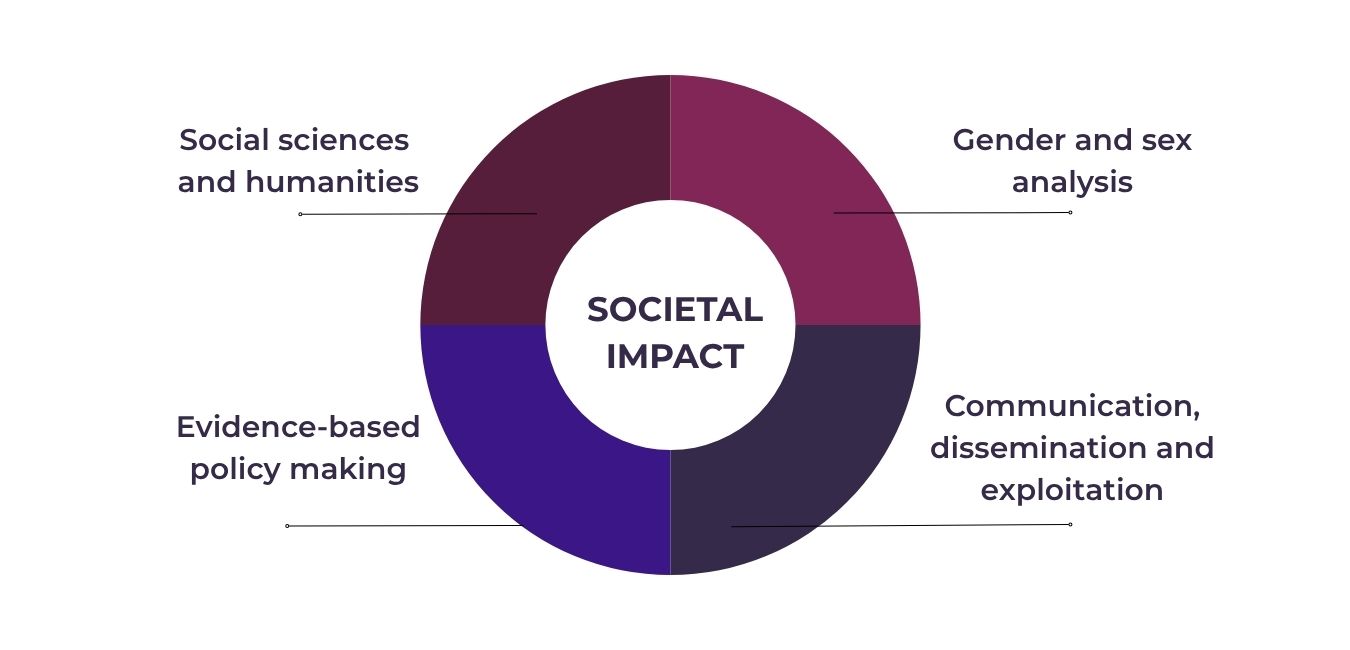
Social sciences and humanities
Adoption is a social question before it is a technical one. Under SSH-flagged topics, approximately one partner in five is an SSH partner, and insufficient integration is reflected in a lower evaluation score.
Evidence-based policy making
For most societal challenges the route to impact runs through a regulation, a guideline or a professional standard of practice rather than through a market. That route has to be identified early and argued in the proposal.
Gender and sex analysis
The gender dimension in research and innovation content is assessed under the Excellence criterion, as part of the methodology. It is distinct from gender balance within the team, and evaluators assess it as such.
Communication, dissemination and exploitation
Article 17 of the Grant Agreement requires activities that are effective, proportionate, strategic and coherent, and states that ad hoc efforts are not sufficient. Non-compliance may lead to a reduction of the grant.

HOW WE WORK
Four stages, one continuous thread
FIRST STAGE
BEFORE SUBMISSION
01 · DESIGN
02 · PROVE
The societal argument in section 2.1 and the full CDE plan in section 2.2, written to the evaluation form.
SECOND STAGE
ONCE PROJECT RUNNING
03 · DELIVER
The specialised work packages and tasks we lead during implementation: SSH research, gender analysis, engagement, policy work, and the CDE plan and its execution.
04 · UPTAKE
Policy uptake and knowledge transfer, usually as a task in the final work package and for as long as the obligations run.
Horizon Europe distinguishes three categories of impact: scientific, societal, and technological or economic. We work on the societal one, and on the communication, dissemination and exploitation function that serves all three. In a technology-led project, that is the part we cover.
We do this from the concept stage through to implementation, as a beneficiary partner leading work packages or as an independent consultant working alongside the coordinator.
WHERE SOCIETAL IMPACT IS LOST
3 situations we are usually called in to resolve
A societal pathway that is asserted rather than argued.
The expected outcomes of the topic are restated rather than translated into specific, measurable contributions attributable to this project. Social and behavioural assumptions are left implicit, and the evaluator has no way of judging whether they hold.
A plan produced too late.
The dissemination, exploitation and communication plan is due as a deliverable six months after signature. Prepared under time pressure, it becomes a compliance document with little relation to the results the project is generating, and difficult to report against.
Results that never reach the people who could act on them.
What the numbers stand for
Track Record
EU-Funded Projects since 2016
Partner Institutions in our Research Network
Peer-Reviewed Publications
How we join, and where we stop
We work in two ways
Beneficiary partner in the consortium
Independent consultant
Working alongside the coordinator without joining the consortium. Both are routine for us, and which one fits depends on the call and on the stage you have reached.
Where we stop
We do not cover the technological or economic pathway
Market analysis, business models, standardisation and intellectual property are not ours, and where a result requires them we say so and work with whoever owns that part of the consortium. Research ethics, integrity and data protection are likewise outside our remit. Naming the boundary is quicker for everyone than discovering it in the
Working towards a deadline
Send us the topic and your draft concept. We will come back with an assessment of where the societal
impact risk lies and what we would do about it. There is no cost and no obligation to work with us
afterwards.