
SERVICES
From societal pathway to policy uptake

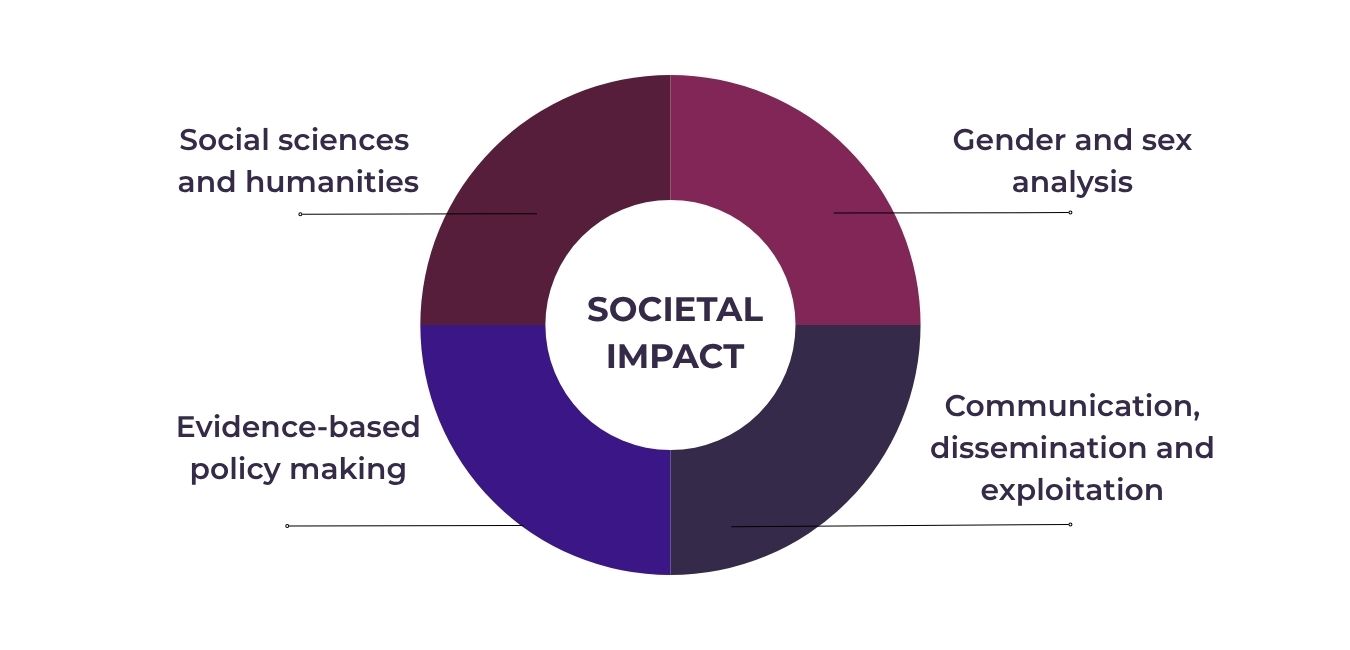
We work towards a single objective across four stages: ensuring that the societal contribution of an EU-funded project is argued convincingly, delivered as planned, and taken up by those who can act on it. Social sciences and humanities, evidence-based policy making, gender and sex analysis, and communication, dissemination and exploitation are the means by which we do it.
Two of these stages take place before submission. The other two are work packages and tasks we lead once the grant is signed, as a beneficiary partner or alongside the coordinator.
01 · Design the societal pathway
BEFORE THE WORK PACKAGES ARE FIXED
Societal impact sections lose points most often because the pathway is written after the science, in order to accommodate it.
We recommend the opposite sequence: establishing which societal outcomes are sought, for whom, measured how, and what might prevent them from materialising.
The work packages are then built to deliver those outcomes rather than the other way round.
- A theory of change for the societal contribution of the project, mapped onto the expected outcomes of the topic and the expected impacts of the destination, so that your contribution is specific rather than a restatement of the call text.
- Target groups broken down into real segments. Naming an audience precisely is what allows the rest of the section to be credible.
- Outcome KPIs with a baseline and a target, so that section 2.1 contains figures rather than adjectives.
- Social, behavioural and regulatory barriers, together with the mitigating measures you would take if your assumptions prove wrong. The template asks for this explicitly and it is frequently omitted.
DELIVERABLES
You receive proposal-ready text, the first version of the plan, and a scored review report.
FOR WHOM
For consortia drafting a proposal, and for consortia with a complete draft who want an independent assessment before submission.
02 · Write it into the proposal
SECTION 2, WRITTEN TO THE EVALUATION FORM
Evaluators read quickly, with the scoring form in front of them. We write the societal argument in section 2.1 and the full plan in section 2.2 so that every claim corresponds to something they are asked to assess, and we review the result as an evaluator would before you submit.
- The societal component of section 2.1, drafted to the annotated template and within its page allocation. Text beyond the page limit is made invisible to the evaluator, so length is a constraint rather than an opportunity.
- The first version of the dissemination, exploitation and communication plan required in section 2.2, which is an admissibility condition in most topics. We lead the dissemination, communication and policy uptake components, and articulate any commercial exploitation route with whoever owns it within the consortium.
- SSH and the gender dimension integrated into the methodology in section 1.2, where they are actually assessed, rather than added as a separate paragraph.
- A scored review of the impact section against the official evaluation form: a mark, the shortcomings an evaluator would record, and a prioritised list of changes with the reason each one raises the score.
DELIVERABLES
You receive proposal-ready text, the first version of the plan, and a scored review report.
FOR WHOM
For consortia drafting a proposal, and for consortia with a complete draft who want an independent assessment before submission.
03 · Deliver the work
THE WORK PACKAGES AND TASKS WE LEAD
Once the grant is signed, our contribution stops being editorial and becomes research and delivery. We lead work packages and tasks in our four areas, produce the deliverables attached to them, and report on them like any other beneficiary. In consortia where we are not a partner, we do the same work alongside the coordinator.
Research and analysis:
- SSH research tasks: qualitative and quantitative fieldwork, surveys, interviews and focus groups, literature and evidence reviews, and the analysis of social acceptance and adoption conditions.
- Gender and sex analysis applied to the research content, including sex-disaggregated data collection and the interpretation of gender gaps in results.
- Policy and regulatory analysis, comparative studies across Member States, and the evidence base behind the project’s recommendations.
- Stakeholder mapping, engagement and citizen participation designed as method rather than as outreach, including the follow-up mechanisms that ensure participants’ contributions are channelled somewhere.
The CDE work package:
- The detailed dissemination, exploitation and communication plan, due six months after signature, and each scheduled update, aligned with the results the project is actually producing.
- Audience segmentation and message design: who needs to know, who needs to act, and what each of them needs to receive.
- Communication that meets Article 17. The Grant Agreement requires activities that are effective, proportionate to the scale of the action, strategic and coherent, and states that ad hoc efforts are not sufficient.
- Dissemination to peers and to communities of practice, including the visibility of public results through the Horizon Results Platform.
- KPI monitoring, with the evidence your periodic reports will require.
DELIVERABLES
You receive the research deliverables assigned to us, the CDE plan and its updates, a communication plan with channels and calendar, dissemination materials, and a KPI dashboard with the supporting evidence.
FOR WHOM
For funded projects, from month one, whether we join as a beneficiary partner or work alongside the coordinator. The most useful time to speak to us is before the consortium is closed, when work packages are still being allocated.
04 · Policy uptake and knowledge transfer
OBLIGATIONS, AND RESULTS, THAT OUTLAST THE FUNDING
Dissemination and exploitation obligations continue for up to four years after the project ends. For societal results, exploitation rarely means a product. It means a recommendation that reaches a directorate, a protocol adopted by a professional body, or a method that becomes standard practice in a service. That is the route we work on.
- Identification of the results whose route runs through policy or professional practice, and of the specific bodies able to take each one forward.
- Policy briefs and recommendations written for the people able to act on them, and delivered to those people rather than published in the hope of being found.
- Knowledge transfer to communities of practice: guidance, protocols and training materials that allow a result to be used by someone who did not take part in the project.
- Continued visibility of public results and support for the reporting obligations that remain after the closure of the grant.
SCOPE
Where a result requires commercial exploitation, intellectual property protection or standardisation, we say so early and work with whoever leads that part of the consortium. Those routes are not ours, and identifying them in time is more useful than improvising them.
DELIVERABLES
You receive a policy uptake plan, the briefs and materials it requires, and a record of the bodies approached and their response.
FOR WHOM
For projects in their final year or already closed, and for public bodies holding results that have not found a route. In most projects this is a task within the final work package rather than a separate engagement.